
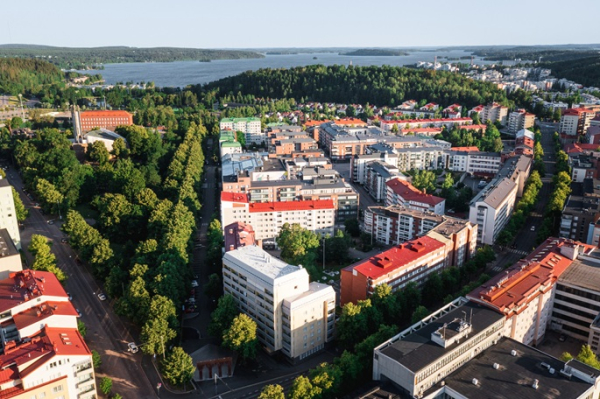

The City of Lahti has become the greenest city in Finland, cutting emissions by 64 percent since 1990, city officials said.
Lahti has become Finland’s first major carbon-neutral city by replacing coal with renewable energy, restoring a once-heavily-polluted lake, redesigning public transportation, and expanding recycling through circular economy initiatives over 26 years.
Fifty years ago, the water in Lake Vesijärvi was so polluted that it came to symbolize the environmental costs of Lahti’s industrial growth. But residents today once again swim in the lake. This reflects decades of environmental investment.
“Lahti’s transformation was prompted by growing concern over pollution and climate change,” Mikko Hallonen, an independent sustainability advisor based in Helsinki, told Daily Finland.
“In Lahti, they wanted to address climate change. There was a concern for the environment and pollution,” Hallonen said.
“They wanted to find ways to achieve sustainable growth to keep the city alive, make it interesting and attractive, and continue to develop sustainably.”
Johanna Särkijärvi, the environmental director and growth services director of Lahti, said that the city’s environmental sustainability strategy had steadily expanded since the 1970s.
“Our journey began with the restoration of Lake Vesijärvi in the 1970s. It evolved into an ambitious effort focused on climate neutrality, the circular economy, biodiversity, and planetary health,” Särkijärvi said. “This is what distinguishes Lahti from other cities.”
“What makes Lahti different is that sustainability is not a separate program or branding exercise,” Särkijärvi said. “It is a long-term development path that has shaped the city for decades.”
Hallonen said that political leaders backed ambitious environmental policies and long-term investments to reshape the city.
Lahti has phased out coal in favor of renewable energy and lower-carbon energy sources, including sustainably sourced biomass, heat pumps, and waste heat recovery, significantly reducing emissions and improving air quality.
“We have achieved significant progress in energy production," Särkijärvi said. “Our first priority is achieving climate neutrality and continuing to reduce emissions across sectors.”
Energy was only one part of Lahti’s transformation. The city has invested heavily in circular economy initiatives, redesigned transportation systems, and promoted sustainable construction.
Rather than treating buildings as disposable, Lahti encourages designing them for reuse.
“Lahti is working hard to implement a circular economy,” Hallonen said. “When you design something like a house, you design it so that when it is taken apart, you can reuse the parts to make new houses.”
Lahti leads in waste recovery, with a Lahti Business Region report showing that it recycles 99 percent of its municipal waste through circular economy initiatives. City officials say that the shift to domestic renewable energy has helped reduce energy bills, while its waste reduction and recycling efforts have reduced landfill and waste management costs.
Hallonen said that sustainability had become part of daily life for Lahti’s residents. They choose public transportation and cycling instead of driving and adopt other sustainable practices because they see the economic benefits.
“People are starting to realize that greener growth and reducing pollution make things cheaper…. Things like renewable energy make energy bills cheaper because they don’t have to import energy,” Hallonen said. “It’s not just morals; it’s combined with making economic sense.”
For Lahti, ensuring that residents see real benefits was an important part of its long-term sustainability planning. According to Särkijärvi, sustainability and economic growth are not opposites.
"We don’t see sustainability and economic growth as competing objectives,” Särkijärvi said. “In Lahti, sustainability is increasingly a source of competitiveness."
Särkijärvi said that the city’s long-term environmental ambitions would create an environment where sustainable businesses could grow.
“Our strategy is to create an environment where companies can develop and scale solutions related to clean energy, the circular economy, sustainable construction, biodiversity, and electrification,” Särkijärvi said. “Strong environmental ambitions help attract investment.”
Särkijärvi said that Lahti viewed sustainability as an economic development strategy.
“That is why our environmental goals are closely linked with innovation, university collaboration, and business growth,” Särkijärvi said. “We believe that the cities that succeed in the green transition will also be the cities that succeed economically.”
Lahti’s sustainability efforts earned recognition after it was named the 2021 European Green Capital. The city then launched public engagement initiatives called the ‘Lahti’s European Green Capital 2021 project’ to encourage residents to participate in and learn about the city’s sustainability efforts.
The campaign reached most of the city’s population. A 2024 City of Lahti Municipal Services survey found that 97 percent of residents were aware that Lahti was the 2021 Green Capital and 72 percent believed that the follow-up project was significant.
Despite this recognition, city officials say that their work is far from finished. According to Särkijärvi, reducing emissions from transportation remains one of the city’s biggest challenges. The city also pursues a nature-positive future in which biodiversity is enhanced rather than depleted.
Hallonen said that other cities hoping to replicate Lahti’s success must take a similar approach to engaging the entire city.
“You need to have a whole-of-city approach… where you engage all stakeholders,” Hallonen said. “People are generally reluctant to change. So, when you explain that this will improve your health, clean the water, improve nature, and bring more business, that’s how you get support.”
Half a century after Lake Vesijärvi had become a symbol of environmental decline, the lake's water now reflects the city's belief that economic growth and sustainability go hand in hand.
- Lahti
- Greenest City
- Finland
Source: www.dailyfinland.fi
